How mega-events, growing audiences, and new use cases are reshaping connectivity requirements
by Webbing Team | January 21, 2026
With both the Winter Olympics and the FIFA World Cup coming up, 2026 is going to be one of the busiest years in the sports calendar. Along with these two major sports festivals, it also includes more mega-events that don’t happen annually, such as the Asian Games and the Commonwealth Games.
Major sporting events keep getting bigger. The Milano-Cortina Olympics are going to be the most spread-out Winter Games in history, with events split not just between two headline cities but also across multiple mountain clusters and with the closing ceremony in Verona. The 2026 edition of the FIFA World Cup™ will also be the biggest FIFA World Cup yet, consisting of 48 teams and 104 matches across the three host countries: the US, Mexico and Canada.
According to analysts, audiences keep growing, too. In 2022, although attendance was restricted due to COVID-19, the Olympic Winter Games in Beijing reached a total audience of 2.01 billion unique viewers. During the 2026 Games in Milan and Cortina, more than two million visitors are expected with a global broadcast audience of around three billion. The World Cup shows the same dynamics. In 2022, FIFA reported around five billion people engaged with the FIFA World Cup in Qatar. At the 2026 World Cup final draw in December, FIFA President Gianni Infantino estimated there will be 7 million people in the stadiums and 6 billion watching games from home.
This increase will definitely put the existing cellular infrastructure to the test and become a major challenge for connectivity providers around the world. Cellular connectivity is critical for modern sports because it provides the most flexible way to keep three essential functions running at once. First, it is vital for thousands of fans streaming and sharing content. Second, it enables venue operations like ticketing and staff coordination, security, and IoT systems. Third, there are broadcasting workflows, where crews increasingly use cellular networks as a fast-to-deploy uplink for live video. And last but by no means least, there are use cases where cellular connectivity is important for athletes themselves.
These applications are quite different in terms of use cases, data usage and connectivity requirements. Let’s take a look at some real-life examples:
Sport Fans and Connectivity Challenges
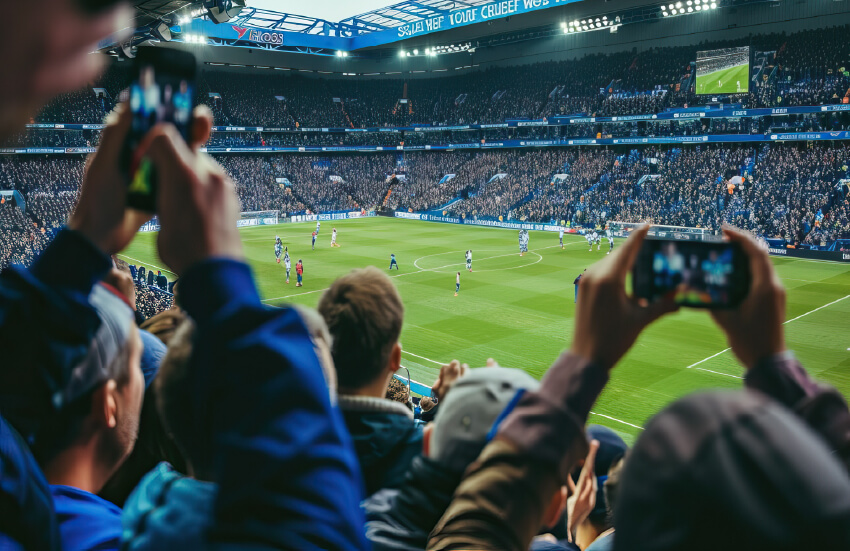
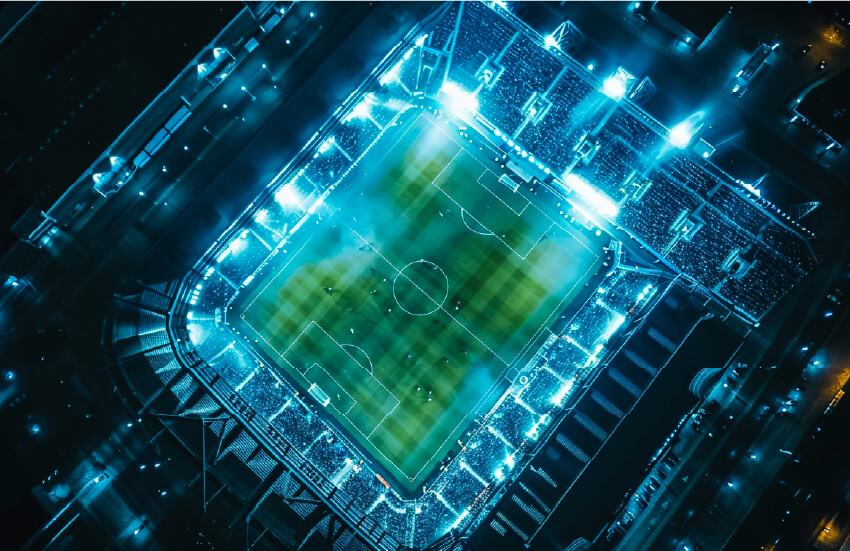
All sporting events, whether in stadiums or open-air venues, face similar connectivity challenges. They concentrate tens of thousands of people in a small area, all using their phones at the same time. The amount of data sports fans use is impressive: reports say that during the 2024 season, average mobile consumption at NFL stadiums increased 37% over 2023, hitting about 960 terabytes. So during halftime, big moments, or the post-game exit, networks are likely to be congested.
To handle this load, operators deploy distributed antenna systems (DAS) and additional small cells to improve coverage and capacity. At Super Bowl LIX in New Orleans, all three major U.S. carriers had to make extensive network upgrades to ensure robust connectivity for fans, media and emergency services. The list of assets installed included hundreds of 5G radios and antennas inside the Caesars Superdome, distributed antenna systems and mobile assets like Satellite Cells on Light Trucks (SatCOLTs) and Cells on Wheels (COW).
Venue Connectivity
Cellular connectivity is widely used to connect operational systems of a stadium or sports complex. This includes security cameras, access control, staff communications, digital signage and sensors for monitoring crowd flow or facility conditions. Since these applications are critical and should not be affected by traffic from fans’ devices, some venues deploy on-site private cellular: for example, State Farm Stadium in Arizona deployed a CBRS LTE/5G network used for staff communications during Super Bowl operations. Private cellular networks are often chosen over Wi-Fi because they offer wider coverage, mobility, better device management, and stronger security controls.
Team and on-field communications also require stable connectivity. In the US, the National Football League is using an in-stadium communications system built specifically to make sure that coaches can communicate with each other during games, without sharing the network with thousands of users.
Broadcasting
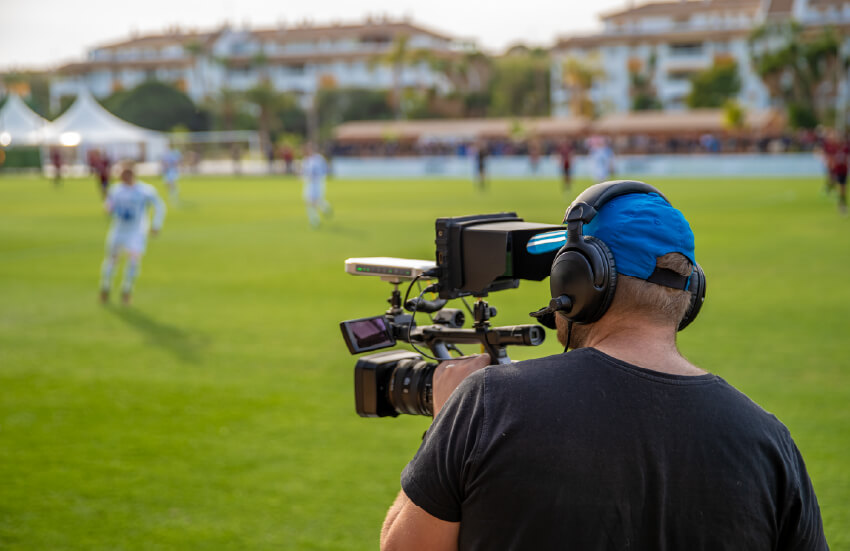
Sporting events often present a significant challenge for live broadcasting. Crews have to deploy quickly and deliver multiple high-quality feeds with very low tolerance for dropouts, while the site itself may not have pre-installed fiber everywhere they need it. At big events, like the Olympics or the FIFA World Cup, many broadcasting teams rely on cellular networks for reasons of mobility or because fixed communications are not available. Cellular connectivity is considered a flexible “anywhere” backhaul, either directly or via bonded cellular units that combine multiple cellular links to increase bandwidth and add resilience.
Yet even smaller-scale events held at venues with fixed communication lines can be very challenging in terms of connectivity. The communication lines may not have sufficient bandwidth, there may be no reliable backup solution, or connectivity may be inconsistent. Satellite solutions are costly and can face issues like signal dropouts, legal restrictions, and roof access problems, while also requiring a bigger crew.
Cellular connectivity is also critical for broadcasting sporting events from remote locations. For example, this year, thanks to cellular technology, the live broadcast of Vasaloppet, the oldest cross-country ski race in the world, was performed with drones. Since 1966, helicopters were used to broadcast it, with an aircraft circulating at an altitude of approximately 3,000 meters to receive the TV signals from snowmobiles filming on the track. A 5G network made it possible to replace these with drones and new camera technology, sending high-quality TV images with minimal delay to millions of viewers worldwide.
Connectivity for Athletes
Cellular connectivity is an important part of sailing and yachting sports events setup. In 2024, Barcelona’s city authorities publicly announced deploying 5G coverage along the waterfront specifically to handle the high connectivity demand around the America’s Cup event areas. In SailGP fleet races, metrics like wing camber, foil position, hydraulic pressure, GPS location, and crew input are streamed in real-time over 5G to onshore data centers and cloud environments, where they are processed and visualized for teams, coaches, and race management.
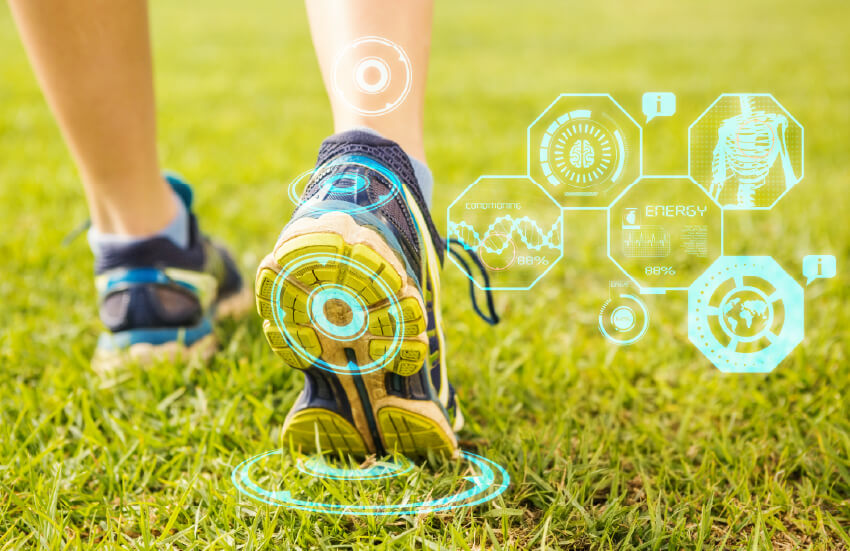
Some athlete tracking devices and wearables use cellular connectivity to transmit performance data, location, or health metrics without relying on a nearby smartphone or local Wi-Fi. It’s not only human athletes who get tracked with this type of solution though. In racehorse training, the on-horse sensor suites automatically upload heart rate, speed and stride metrics to the cloud via a secured 4G mobile connection.

Connectivity Requirements for Modern Sports
With all these different usage scenarios and challenges, ensuring stable connectivity at a sporting event may seem a complicated task. Since applications of cellular technology in sports vary so much, and each use case may need a custom-made connectivity, it’s hard to find common connectivity demands. However, there are several requirements that apply to virtually every use case.
Reliable Coverage and Multiple Network Access
Reliable coverage across the entire venue matters not only for fans: any localized degradation can result in long gate lines or disrupted video production. But since coverage and capacity can vary by location and by operator, and many sporting events are held in remote locations, having access to multiple networks increases the chance that devices can connect to a cellular tower with a better signal. It also adds resilience: if one network experiences an outage or severe overload, connectivity can fail over to another.
Predictable Latency and Bandwidth
At every major sporting event, there is a crowd of people using their phones, and many of them stream video or send pictures, using the uplink that is critical for broadcasting and competing with operational traffic. To overcome these hurdles, broadcasting companies and venues use cellular bonding solutions. But, although these solutions and 5G capabilities can improve the stability and speed of connection, to guarantee a robust and reliable uplink they still depend on a cellular connectivity provider’s network. Actual latency also depends on the core network architecture, since data has to travel all the way to the provider’s data center before going to its destination.
Operational Control
Continuity depends on having ways to keep critical communications prioritized and to shift devices or traffic quickly when conditions change. Real-time visibility into traffic load and connectivity health is very important for understanding what’s happening and adapting without disrupting ongoing operations.
SIMs
Some cellular solutions may have limitations such as complicated local SIM card configurations and data caps. The SIMs used in devices at sporting events, be it a cellular bonding device or a drone, can directly influence the performance and reliability of the connection. Typically, SIMs from different local carriers are utilized to improve network reliability and coverage. Some SIMs allow for international roaming or guarantee coverage in regions where other carriers might have limited service. This can be especially beneficial for broadcasting from remote locations.
But what may be more important, different SIMs come with various data plans, including costs and speed limits. Choosing the right SIMs can help optimize the cost and performance of the device. However, this may mean contracting with multiple carriers in every region where connectivity is needed.
With different SIM options to choose from, SIM capabilities are critical, too. The most illustrative example is what happens if one of the networks used by a bonding device is down for some reason. With a regular SIM, data speed will be limited to what is left from all other SIMs in the device. With an eSIM capable of switching between different profiles, the device will connect to the best available network and use it instead of the malfunctioning one.

Webbing’s Solution for Sports
Webbing offers a connectivity solution that ensures global access to reliable and high-quality internet with low latency. It provides secure and continuous internet connection for all types of devices at sporting events.
Webbing’s connectivity solutions guarantee global coverage, and through our ecosystem of over 600 mobile operators worldwide, devices can roam seamlessly across multiple carriers’ networks in every region. It solves the problem of weak spots that any mobile network may have and ensures full coverage and continuous connectivity for all devices, even at remote locations.
Our eSIM solution, WebbingCTRL, ensures failover connectivity with the capability of using multiple mobile carrier profiles, easily switching carriers at any time with zero integration, and an option to fall back from a failing profile to a different profile without any need to communicate with a remote server.
WebbingCTRL enables organizations to remotely add, remove, and swap operators for any number of devices immediately without operator integration or collaboration. It also provides a centralized way to manage eSIMs/SIMs lifecycle and profile inventory, as well as visibility into device data usage. Companies can set up business rules that would allow devices to change the serving operator automatically under specific conditions, such as location, country, loss of connectivity or even after a certain amount of time. Webbing’s eSIM is aligned with the GSMA SGP.32 IoT eSIM specification. The WebbingCTRL platform can work with both SGP.32 and SGP.22 standards and also supports M2M devices for relevant use cases. It provides a single pane of glass to manage all devices deployed regardless of standards used.
More than 1 million WebbingCTRL eSIMs/SIMs have already been deployed globally. Our eSIM cards have helped organizations benefit from cellular connectivity at various sporting events: for example, to connect almost 1900 devices facilitated in broadcasting events and competitions at the Paris Olympics in 2024 and to guarantee seamless global connectivity for innovative solutions used by the Professional Squash Association to broadcast squash tournaments.
Webbing’s distributed core network with local breakouts, multiple network solution, and data server redundancy provides connectivity stability and low latency. It also allows to easily comply with local regulators’ requirements and helps to adapt to any changes in legislation. Besides, it gives enterprises the ability to quickly scale their deployments or adjust their existing device management to any business scenarios.
Moreover, a flexible approach to data packages allows us to tailor our connectivity offering for every customer based on the type of connected devices and their data consumption needs as well as the locations where the devices are used, aiming at overall optimization of the total cost of operations for the client.
Contact us today to learn how Webbing’s eSIM and global connectivity solution can help you connect any type of device at sporting events securely, reliably and at scale.