How mobile networks enable reliable inspection and automation across factories and in the field
by Webbing Team | November 19, 2025
According to GSMA data, manufacturing is expected to be the leading industry beneficiary of 5G, driving over a third (36%) of the technology’s estimated $930 billion contribution to the global economy by 2030, with demanding applications such as machine vision quality control called out as key drivers. It goes both ways: 5G also accelerates machine vision adoption. But what is the connection between cellular connectivity and machine vision?
Simply put, machine vision systems really have two parts: the “eyes”, which are the cameras or robots that capture images, and the “brains”, which are the computers that analyze those images and decide what’s good, bad, missing, or damaged. Cellular connectivity is crucial here because the eyes and the brains are often not in the same place. The cameras might be on a robot moving inside a sewer or attached to a machine that can’t easily be wired, while the analysis may run on a nearby edge server or even in the cloud. For the system to work smoothly, the images must reach the brain quickly, and the decisions must get back to the machine without delay. Cellular networks provide a reliable wide-area link between the two so they stay in sync, even when the equipment is moving or spread out.
Machine vision applications also produce a lot of uplink-heavy and time-sensitive data. Cellular connectivity can handle this kind of traffic well and keep delays stable enough for real-time decisions. Besides, many machines, robots, and inspection tools live in places that are hard to reach with cables or where Wi-Fi is unreliable, and cellular coverage fills these gaps. When scaling to dozens or hundreds of cameras, cellular makes it easier to keep everything running smoothly without slowing down the rest of the network. It also comes with built-in device identity, encryption, and remote update capability, which means that cameras and robots can stay secure and up to date without someone visiting each one.
Overall, while you may not need cellular for every small fixed camera that sits next to a computer, it becomes essential as soon as your machine vision tasks involve mobility, remote access, large sites, or centralized analytics. In those situations, cellular connectivity is what makes the whole system practical to deploy, operate, and scale.
Let’s look at the most typical use cases of cellular connectivity in machine vision applications:

Inline Quality Inspection & Defect Detection
In this type of use case, fixed cameras scan products or parts on a production line, detecting defects such as surface scratches, misalignment or missing components.
Cellular connectivity enables uploading high-resolution image data in real time or near-real-time to a cloud or central analytics system that checks for defects. Cellular networks provide a dedicated lane for heavy camera-to-computer traffic, so pictures don’t stutter or drop, and the delay stays steady enough for instant “pass/fail” decisions and reject mechanisms. Because it uses licensed airwaves, cellular connectivity is less prone to random interference than crowded Wi-Fi, so performance is predictable. What is also important is that one cellular network can cover large indoor and outdoor areas, where installing new cabling would be slow or costly.
A trial run in 2023 by Hitachi Astemo Americas was a perfect demonstration of all the advantages of cellular connectivity for this application. At the electric motor vehicle manufacturing plant in Berea, Kentucky, they placed cameras on an active assembly line and sent real-time 4K video over a private 5G network to an on-site edge computer device running video analytics. The system was installed in three days and used for defect detection. Enabled by the high throughput and low latency needed to move large video volumes for instant analysis, computer vision running on 5G could identify sub-millimeter defects and inspect 24 assembly components simultaneously, rather than one-by-one.

Robotic Guidance & Pick-And-Place Verification
In many factories, 2D and 3D cameras guide robots in assembly, bin-picking or part placement, verifying correct orientation and tolerance. Robotic guidance and pick-and-place work best when the robot’s cameras can send a steady stream of clear images to the computer that figures out where parts are and whether they’re positioned correctly.
At ZTE’s Binjiang 5G factory in China, a vision-guided robot uses a binocular camera and force sensors to automatically plug and unplug network cables with about 0.1 mm insertion tolerance. The robot also connects optical modules, inserts and removes boards, and replaces tooling and fixtures, successfully integrating over ten automated processes. This robot is part of a broader setup in which more than 150,000 devices are connected over a private standalone 5G network.
Cellular connectivity is built for this type of application because it keeps a reliable link as robots move around the floor, supports smooth hand-offs between antennas, and performance stays predictable. It also reaches across large indoor and outdoor areas where Wi-Fi may be patchy and cables are impractical, and it uses licensed airwaves that are far less prone to random interference.

Remote Asset Monitoring and Field Inspections
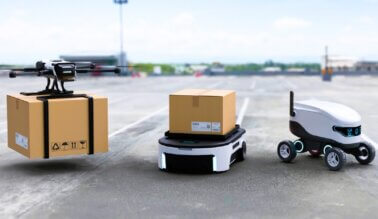
In these applications, cameras inspect industrial equipment, machines or pipelines for wear, corrosion, cracks, leaks and other problems; in many cases, robotic crawlers or drones are used.
These use cases critically depend on cellular networks, because the assets that need monitoring are often in remote locations or where wired infrastructure is lacking – for instance, in sewers, wind farms, storage yards or mines. Cellular networks enable connectivity for video upload and analytics: public networks already blanket most roads and populated areas, and private 5G can fill gaps on big industrial sites. The link makes it possible to coordinate teams and machines over long distances and get faster alerts when something looks wrong without waiting for someone to physically bring the data back on a USB drive.
For example, the Borough of West Homestead, Pennsylvania, started using pipe inspection robots and cloud suite to inspect and manage their sewers. They deploy machine-vision robots that capture high-resolution footage in underground pipes and upload the results directly from the field over 5G or LTE, instead of hauling video back to the office. This approach allows for faster analysis, quicker maintenance decisions, and far less administrative overhead – the shift to cellular-connected inspection robots helped the borough cut costs by more than $100,000 in a single year.

Connectivity Requirements
Depending on the use case, some machine vision systems may have slightly different connectivity requirements, but typically they will all have common demands.
Coverage
Machine vision devices may operate in large plants, outdoor yards, remote sites, underground, or inside metal-heavy environments. They need stable coverage in places where Wi-Fi is weak, inconsistent, or unavailable, and where cabling is impractical.
Webbing’s ecosystem of 600+ mobile operators guarantees worldwide coverage and allows to roam on several carriers’ networks in every region, solving the problem of weak spots that any mobile network may have and ensuring full coverage and continuous connectivity even at remote locations.
Latency
All machine vision systems are critically dependent on latency. While some machine-vision tasks don’t need ultra-low latency, they do need consistent timing. When the delay varies, it can lead to inconsistent pass/fail decisions or unstable robot motion.
Theoretically, cellular networks can provide latency as low as 1ms. But actual latency depends on the core network architecture: the data sent by the device needs to travel all the way to the connectivity provider’s data center before going to its destination.
Webbing is a full MVNO that owns its core network, which is a fully redundant, distributed network with data centers on every continent. It features local breakouts and a variety of network solutions to support high-performance connectivity, and allows to guarantee high data throughput and low latency to all connected devices.
Bandwidth
Machine vision systems send a lot of data upstream from cameras to the processing system. Whether it’s full video or bursts of images, the network must provide high, steady upload speeds without choking when multiple devices send data at once, which requires a significant amount of bandwidth. However, enterprises are dependent on a cellular connectivity provider to guarantee a robust and reliable connection. So at the contracting stage, it’s important to make sure there are no additional limitations such as throttling.
Webbing’s core network is well suited to support all types of use cases, including mission-critical and high-data consumption. We also do not throttle or restrict data at any level but enable the capability for customers to throttle as they see applicable with our on-demand usage control policies and further features to control usage with content filtering options.
Webbing’s Solution
Webbing offers a connectivity solution that ensures global access to reliable and high-quality internet, with low latency and the best of class coverage. It provides secure and continuous internet connection for devices using machine vision, wherever they need it.
Our ecosystem of 600+ mobile operators guarantees worldwide coverage and allows to roam on several carriers’ networks in every region, solving the problem of weak spots that any mobile network may have and ensuring full coverage and continuous connectivity even at remote locations.
Webbing is a global connectivity provider with a distributed full core network with local breakouts, multiple network solution, and data server redundancy that provides connectivity stability and low latency. As such, Webbing’s network is well suited to support mission-critical, high-data consumption type of use cases. It also allows for compliance with all types of connectivity regulations.
Our eSIM solution ensures failover connectivity with the capability of using multiple mobile carrier profiles, easily changing carriers at any time with zero integration, and an option to fall back from a failing profile to a different profile without any need to communicate with a remote server or deal with multiple SIM cards.
A flexible approach to data packages allows us to tailor our connectivity offering for every customer based on the type of connected devices and their data consumption needs as well as the locations where the devices are used, aiming at overall optimization of the total cost of operations for the client.
Reach out to learn more about Webbing’s solutions.