
How cellular connectivity powers digital transformation in education and bridges the digital divide
by Webbing Team | December 4, 2025
Over the last 25 years, education, like many other sectors, has undergone a major digital transformation. As cloud services and affordable mobile hardware such as tablets pushed applications to the web, institutions moved courses and back-office systems online. The COVID-19 pandemic was a decisive catalyst: closures drove near-universal remote learning, with rapid adoption of Learning Management Systems (LMS), device take-home programs, and cellular hotspots for off-campus access. The process is ongoing: today, growing AI use continues to drive further expansion of digital tools across teaching, learning, and school operations.
However, this fast transformation brings about certain difficulties, in particular the gap between students and schools that can fully use digital tools and those that can’t, which is known as the digital divide. Reliable connectivity is a critical prerequisite for digital technologies’ adoption. The UNESCO “Technology in Education” report states that “the right to education is increasingly synonymous with the right to meaningful connectivity, yet access is unequal. Globally, only 40% of primary, 50% of lower secondary and 65% of upper secondary schools are connected to the internet; 85% of countries have policies to improve school or learner connectivity”
Cellular connectivity is an essential pillar of the digital shift in education, and an important way to help address the digital divide. While less crucial for on-campus classroom connectivity, where it remains a backup for primary Wi-Fi, it is vital for equity and mobility, as hotspots and LTE or 5G devices keep learners connected off-premises. Alongside learning, cellular connectivity powers a wide range of operations in both K-12 and higher education. It enables safety alerts and staff communications that keep working when campus Wi-Fi is down, supports transportation, facilities and asset management, as well as provides connection for security cameras.
Let’s take a look at how cellular connectivity enables different use cases in education:

Hard-To-Serve Areas
One of the most obvious use cases is connectivity in certain areas that lack reliable fixed broadband, so cellular connectivity is the fastest and most practical way to get schools and students online. 4G and 5G networks can cover wide, sparsely populated regions without running new fiber to every home, so school districts can provide access in weeks using hotspots and cellular-enabled devices. Cellular technology also offers resilience when local wired links fail due to storms or construction cuts. With pooled data plans and eSIM for multi-carrier coverage, cellular connectivity becomes the flexible “last mile” that keeps learning and school operations reachable in places with no fixed communications.
A good example is the biggest tribal school in Washington, Chief Leschi School. For 630 or so students, who come from three counties, the campus’ remoteness and the often difficult terrain surrounding it can make getting to school a challenge. When the campus was required to immediately shift to remote learning because of the pandemic, many students didn’t have the necessary devices to do online schooling, and those that did often lacked Wi-Fi access. The school provided mobile hotspots, remote learning devices and unlimited data plans to students without home Wi-Fi, substantially narrowing its digital access gap, so now 100% of its students take advantage of online learning.
Campus Research and Advanced Programs
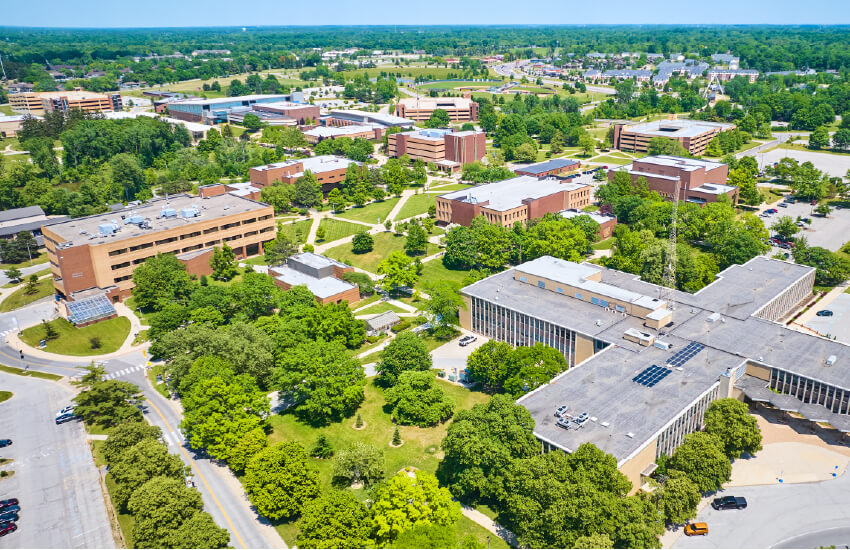
Cellular networks, especially private 5G, let universities run experiments and advanced projects that need reliable mobile connectivity beyond campus Wi-Fi. At Northeastern University, a private network fully automated through AI provides connectivity to smartphones, cameras, and 5G dongles for video conferencing and streaming. Last year, the University of Nebraska announced that it’s building a private 5G network to give researchers reliable, secure connectivity on and off campus. The network includes base location sites on several campuses, and a research farm located approximately 30 miles outside the city of Lincoln, as well as a mobile site to support researchers travelling to remote areas. Reliable connectivity is essential for researchers out in the field who need to collect and transmit data in real-time and avoid travel to perform tasks that could be automated or performed remotely.

Connected School Buses
Cellular connectivity turns school buses into learning-ready vehicles. It provides filtered Wi-Fi for students to study on long routes and keeps field trips and special ed connected far from school networks. Besides, it simplifies fleet management, which is important, especially if there is only one dedicated staff member overseeing the entire bus fleet. Cellular networks power two-way communications, real-time GPS and support telematics to cut costs and downtime.
For instance, Greenville County Schools in South Carolina implemented LTE routers in their fleet of 425 buses. It helped them turn school bus time into homework time: with a maximum of 77 students per bus, it can give students up to 28,000 hours of additional instruction time. The service includes a WiFi access point, GPS and telematics integration, cloud configuration and troubleshooting, and options for live streaming video for school bus tracking and monitoring.
Safety and Security
Cellular connectivity is vital for safety and security because it’s independent of the campus network and usually more resilient in a crisis. When Wi-Fi is congested or down, cellular provides a reliable link for panic alerts and mass notifications. For example, FirstNet offers a school safety solution that includes a dedicated badge-style device that connects over cellular networks to send an emergency alert directly to 9-1-1 and simultaneously notify staff, with device health checks and location data. Cellular links also backhaul security devices at remote sites such as cameras or sensors.

Connectivity Requirements for The Education Sector
With so many different applications, each use case is likely to have very specific connectivity demands. However, there are several common requirements that are relevant for almost every application.
Coverage
Coverage is crucial because education now happens everywhere, and the tools that power it, such as LMS or video, only work where there’s a signal. Gaps in coverage that leave certain areas “dark” can break instruction and testing. Students without reliable coverage simply may not access their homework.
Webbing’s ecosystem of 600+ mobile operators guarantees worldwide coverage and allows to roam on several carriers’ networks in every region, solving the problem of weak spots that any mobile network may have and ensuring full coverage and continuous connectivity even at remote locations.
Reliability
No single network covers every bus route or neighborhood equally, and outages happen. A multi-carrier setup lets devices pick the best signal per location and failover automatically during incidents or congestion. It also improves safety, since panic alerts still go out even if one network is down, and keeps buses online. Operationally, it also enables cost optimization and smoother device management at scale.
Webbing’s eSIM solution ensures failover connectivity with the capability of using multiple mobile carrier profiles and an option to fall back from a failing profile to a different profile without any need to communicate with a remote server or deal with multiple SIM cards. If there’s a weak spot in any mobile provider’s network, the device will simply switch to another network.
Latency
A lot of modern education is interactive, and low latency is important to keep live classes in sync. It also lets safety alerts arrive immediately. Besides, it is crucial for research work: robotics, drones, and lab equipment need quick control loops.
Technically, cellular connectivity can provide latency as low as 1ms, but actual latency depends on your connectivity provider’s core network architecture, since the data has to travel all the way to the data center before going on to its destination.
Webbing is a full MVNO that owns its core network, which is a fully redundant, distributed network with data centers on every continent. It features local breakouts and a variety of network solutions to support high-performance connectivity, guaranteeing high data throughput and low latency to all connected devices.
Webbing’s Connectivity Solution for Education
Webbing delivers a powerful end-to-end connectivity solution that meet the unique needs of schools, districts, and higher education institutions. It simplifies device management, maximizes uptime for learning applications and keeps every device – from student tablets to safety systems – securely connected.
Webbing’s connectivity solutions guarantee global coverage, and through our ecosystem of over 600 mobile operators worldwide, devices can roam seamlessly across multiple carriers’ networks in every region. It solves the problem of weak spots that any mobile network may have and ensures full coverage and continuous connectivity wherever education happens.
Webbing is a full MVNO that has a fully redundant distributed core network infrastructure with data centers on every continent. It is well suited to support mission-critical, high-data consumption education use cases that require connectivity stability and low latency such as live instruction, testing platforms, research applications, and real-time safety communications. It also allows for all types of localization, making it easy to comply with local regulation requirements even in heavily regulated markets.
Our eSIM solution ensures failover connectivity with the capability of using multiple mobile carrier profiles, easily changing carriers at any time, and an option to fall back from a failing profile to a different profile without any need to communicate with a remote server. Webbing also offers a portal to manage eSIMs throughout their lifecycle. It allows for defining business rules that govern the automatic profile swap process and provides visibility to profile usage and network events, to guarantee transparent connectivity. With Webbing’s solution the education sector can manage large fleets of student devices, buses, security equipment, and campus IoT deployments at scale as well as monitor and control the data usage of each device.
A flexible approach to data packages allows us to tailor our connectivity offering for every customer based on the type of connected devices and their data consumption needs as well as the locations where the devices are used, aiming at overall optimization of the total cost of operations for the client.
Our solutions help e education sector overcome their connectivity problems, providing the benefits of roaming with multiple carrier options and seamless transition between carriers with a single SIM.
Reach out today to learn more about Webbing’s connectivity solutions for the education sector.