Why reliable cellular connectivity is essential for scalable self-driving taxi operations
by Webbing Team | February 18, 2026
Self-driving taxis are no longer theoretical, they are operating as a real mode of urban transportation. Waymo says it provides more than 250,000 paid trips per week across Phoenix, San Francisco, Los Angeles, and Austin. Baidu reported 2.2 million fully driverless rides in Q2 2025. But what do these numbers actually say about adoption?
For scale, in 2024, Uber completed 11.2 billion trips globally, and Chinese ride-hailing company Didi reported 12.392 billion trips in China. These networks move tens of millions of users daily, whereas leading robotaxi services are doing tens of thousands of trips per day. Taking this into account and remembering that self-driving taxis are only available in a handful of places around the world, it is safe to say that robotaxi adoption is real but currently small relative to mainstream ride-hail demand.
Five years ago, the forecasts of autonomous taxi adoption were optimistic. Cruise planned to have tens of thousands of Origin AVs on roads by 2024, and Elon Musk promised over a million robotaxis on the road by the end of 2020. In fact, by the end of 2024, GM shut the Cruise robotaxi business down, and Tesla only started limited operations in June 2025 in Austin, Texas, with 10 to 20 vehicles.
Even the companies that managed to roll out their fleets and successfully scale them can’t boast tens of thousands of robotaxis. Waymo reported that their fleet surpassed 2000 taxis in August 2025, and Baidu Apollo Go mentioned “over 1,000 fully driverless vehicles” in July 2025, with most other operators deploying significantly smaller fleets.
Robotaxis were slower to develop than expected, and one of the operational constraints contributing to this slower rollout is their vulnerability related to connectivity. But how exactly can connectivity impact autonomous taxis?
Why stable connectivity is a must for self-driving taxis
Stable connectivity is not optional for driverless passenger service, it is effectively a regulatory prerequisite. Robotaxi operators are obliged by regulators to maintain reliable wide-area connectivity, which in practice is most commonly provided by cellular networks. For example, the California Public Utilities Commission authorized a pilot program for the transportation of passengers in autonomous vehicles on the condition that “a communication link between passengers and “remote operators” of the vehicle must be available and maintained at all times during passenger service”. Loss of that link is treated as a safety and compliance issue, not merely a technical inconvenience.
It should also be noted that although regulators typically avoid naming specific radio technologies (such as cellular, LTE, or 5G), the requirement for continuous, city-wide mobile connectivity in real traffic conditions effectively makes public cellular networks the only practical solution.
How connectivity impacts robotaxi operations
The reason behind regulators’ demands was simply practical, and it has been demonstrated by multiple connectivity issues that directly impacted robotaxi operations in the real world.
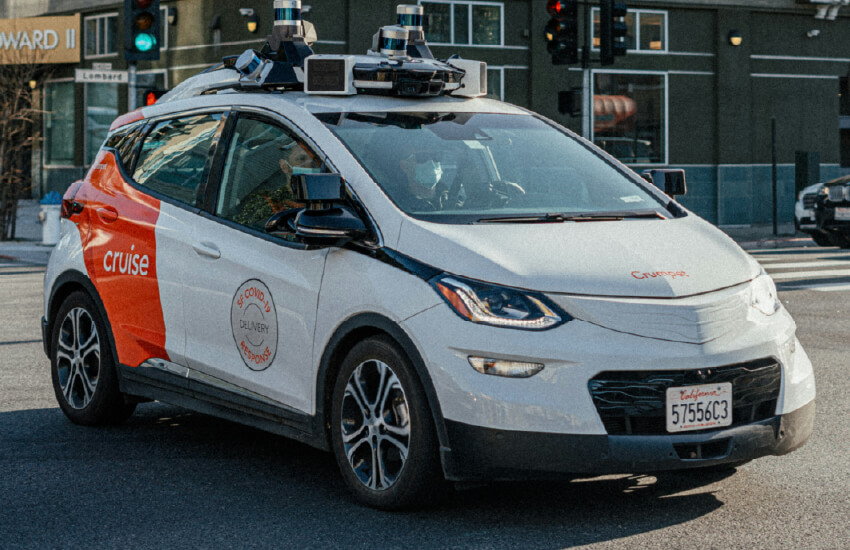
One of these incidents became a widely cited example of cellular connectivity’s impact on autonomous taxis. In August 2023, multiple Cruise vehicles stalled and caused a traffic jam in San Francisco because a nearby music festival overwhelmed local cell phone networks, leading to connectivity issues.
However, it wasn’t the first incident involving Cruise. In May and June 2022, Cruise self-driving vehicles blocked the streets of San Francisco following outages, and the company was unable to see where the vehicles were located, communicate with riders inside, or even access its system which allows remote operators to safely steer stopped vehicles to the side of the road. The incident was reported as vehicles losing contact with the company servers.
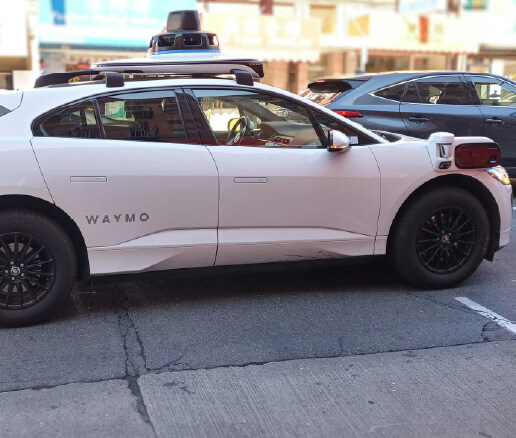
It’s not only Cruise, either. On December 20, 2025, a widespread power outage in San Francisco led to Waymo robotaxis stalling and snarling traffic. The company explained that although the vehicles are designed to handle non-operational traffic signals as four-way stops, many requested a “confirmation check” from Waymo’s fleet response team to make sure what they were doing was correct. With such a widespread outage, there was a “concentrated spike” in these confirmation requests, which caused the congestion. Although Waymo did not attribute it to cellular failure, it was an illustration of why communications availability and scalability are critical.
There were also other types of incidents where connectivity proved to be crucial. In June 2024, in Phoenix, Arizona, a Waymo robotaxi that came upon a construction zone was driving the wrong way into oncoming traffic. The illegal maneuver was spotted by a police officer, who promptly turned on his cruiser’s emergency lights in an attempt to pull it over. That did not work: instead, the Waymo proceeded right through an intersection before coming to a halt. Luckily, the officer was able to communicate with a Waymo support employee via remote assistance – which was possible thanks to cellular connection.
While these incidents were not all caused by connectivity failures, they illustrate how critical reliable communications are: without a reliable connection between the car and support team, oftentimes it is impossible to solve the problem.
How robotaxis operators use cellular connectivity
In any situation that requires remote control of a vehicle, cellular connectivity is indispensable, because it’s the main enabler of remote driving or teleoperation. Some companies, such as Baidu’s Apollo Go in China, have used fully remote backup drivers who can step in to virtually drive the vehicles. Others claimed they don’t use remote drivers, and therefore do not rely on cellular connectivity for the dynamic driving task. Waymo specifically explained that their self-driving vehicles are not reliant on a continuous wireless connection for safe operation: “We don’t want to have a situation where, say, if the car lost cell connection, it couldn’t make a left turn. Therefore, everything from custom made maps to robust neural nets that inform our perception and routing runs on board.”
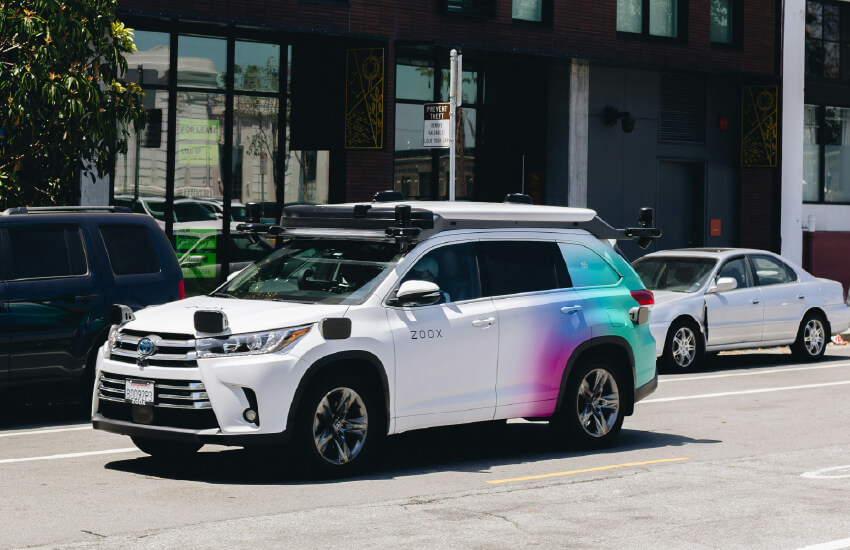
Yet, even if they don’t use cellular connectivity for remote driving, operators still require continuous real-time data exchange with vehicles, and there is no practical alternative to cellular networks for this at city scale. Waymo has stated that their vehicles are equipped with a cellular connection, which is used to supplement the autonomous driving system with real-time road conditions. Besides, Waymo explains their fleet response team can view real-time feeds from the vehicle’s exterior cameras and a 3D graphical representation of what the car perceives around it. They can also rewind available feeds to understand the immediate scene better. Similarly, Zoox has a dedicated TeleGuidance team that provides advice to autonomous vehicles, providing “a human point of view, like a second pair of eyes, to any new situations and scenarios the AI may not be able to navigate on its own”. Although not remotely controlling the vehicles, they “help by assessing the scenario and suggesting a path for the vehicle to follow”, which likewise depends on stable, low-latency cellular connectivity.
Reliability, Latency, and Bandwidth: The Three Pillars of Robotaxi Connectivity
Regardless of the areas where robotaxis operate, their connectivity demands are similar to that of any connected vehicle, but with extra focus on reliability and resilience.
Reliability
Robotaxis must maintain a continuous data link in any part of the city to support dispatching, fleet monitoring, passenger communications, and comply with regulatory requirements. This requires not only good coverage but also redundancy, such as access to multiple cellular networks and fast recovery from any possible dropouts.
Webbing’s ecosystem of 600+ mobile operators provides access to several carriers’ networks in every region, solving the problem of weak spots that any mobile network may have and ensuring full coverage and continuous connectivity anywhere. Additionally, our eSIM solution guarantees failover connectivity with multiple mobile carrier profiles, with an option to fall back from a failing profile to a different profile.
Latency
Since driving vehicles remotely on public roads relies on cellular data connections, it has a major potential problem: operating with a lag. While cellular networks can provide latency as low as 1 ms, actual latency depends on your connectivity provider’s core network architecture, since the data needs to travel all the way to the provider’s data center before going to its destination.
Webbing is a full MVNO that owns its core network, which is a fully redundant, distributed network with data centers on every continent. It features local breakouts and a variety of network solutions to support high-performance connectivity, and allows to guarantee high data throughput and low latency to all connected devices.
Bandwidth
Robotaxis need sufficient uplink throughput to send real-time video feeds, and enough downlink capacity to receive OTA software updates and other data from operators. And problems with bandwidth can force vehicles to stop, as seen in real-world incidents when wireless bandwidth degraded.
Webbing’s core network is well suited to support all types of use cases, including mission-critical and high-data consumption. We also do not throttle or restrict data at any level but enable the capability for customers to throttle as they see applicable with our on-demand usage control policies.
Webbing’s Global Connectivity Solution for Autonomous Fleets
Webbing offers secure, low-latency connectivity that enables the global deployment, operation, and monitoring of connected vehicle fleets. Our connectivity solution guarantees global coverage, and through our ecosystem of over 600 mobile operators worldwide, devices can roam seamlessly across multiple carriers’ networks in every region. It solves the problem of weak spots that any mobile network may have and ensures full coverage and consistent connectivity for distributed deployments in any location.
Webbing’s distributed core network with local breakouts, multiple network solution, and data server redundancy can provide self-driving taxi operators connectivity stability and low latency. It also allows for all types of localization – from IP traffic that remains in the country to designated profiles for emergency calls, so it’s easy to comply with local and regional connectivity regulation requirements even in the most regulated markets, such as Turkey.
Our eSIM solution ensures failover connectivity with the capability of using multiple mobile carrier profiles, easily changing carriers at any time with zero integration, and an option to fall back from a failing profile to a different profile without any need to communicate with a remote server. Webbing’s eSIM is aligned with the GSMA SGP.32 IoT eSIM specification, which means it will be fully compatible with the new standard when it becomes ubiquitous.
Webbing also offers a centralized way to manage eSIMs throughout their lifecycle, making deployments future-proof and eliminating the problem of ever-changing legislation. With our solutions, operators can define business rules that automatically change the serving carrier based on location, connectivity quality, regulatory constraints, or time-based conditions.
By providing roaming with multiple networks support, seamless carrier transitions, regulatory-compliant localization, and low-latency global connectivity, Webbing can help autonomous taxi operators reduce deployment risk, shorten time-to-market, and operate driverless services with the reliability regulators and passengers expect.
Reach out to learn how our connectivity solutions can support scalable and compliant autonomous taxi deployments.