Live operations, fares, safety, and passenger info powered by mobile networks
by Webbing Team | November 4, 2025
Among all the connected cars on our roads, there’s a special class of connected vehicles: buses, trams, and trains. While regular connected cars are often likened to consumer gadgets on wheels, these vehicles are rather rolling parts of a public service. However, their need for stable connectivity is even greater, and the same cellular technology that streamlines logistics fleet management and improves automotive safety powers public transportation as well, keeping it running smoothly by synchronizing operations, fare payments, safety systems, and passenger information in real time.
The evolution of connected public transport vehicles mainly happened over the last 35 years. In the 1980s–90s, transportation agencies were still using analog voice radio and collected data in batches at the depots. In the early 2000s, cellular technology enabled the first citywide bus tracking systems, but only in the 2010s did 3G and 4G provide enough bandwidth and low latency for onboard Wi-Fi backhaul and live retrieval of CCTV clips. It also enabled a shift from stored-value cards to use cases that require an always-on link, like account-based ticketing and open-loop contactless (tapping a bank card or a phone). As agencies moved to cloud platforms, dispatch, video, and fare systems left local control rooms for scalable services, making “vehicle-to-cloud” the standard model.
Today, the number of connected public transport vehicles keeps growing. According to Transforma Insights’ report, there were about 5.4 million connected devices in road public transport in 2024, and this number is forecast to rise to 7.2 million by 2034. That number includes devices used for fleet management, ticketing, passenger Wi-Fi, safety, etc., and many vehicles carry more than one device, so the absolute number of connected vehicles can be lower but still very significant. Add to it connected trams, passenger trains and, in many cities, river boats and ferries.
Let’s look at four distinct categories that cover the majority of use cases and show how cellular connectivity can help transportation agencies and passengers.

Passenger Services
Because connectivity must follow the vehicle and not the route, service quality needs to remain consistent, to improve satisfaction and keep the passenger journey smooth end to end. Connected transport vehicles are typically equipped with a multi-modem cellular router that bonds multiple carriers and exposes a secure LAN for the passenger and onboard systems. Along with onboard Wi-Fi, these cellular links provide connectivity for real-time info displays and mobile ticket validators.
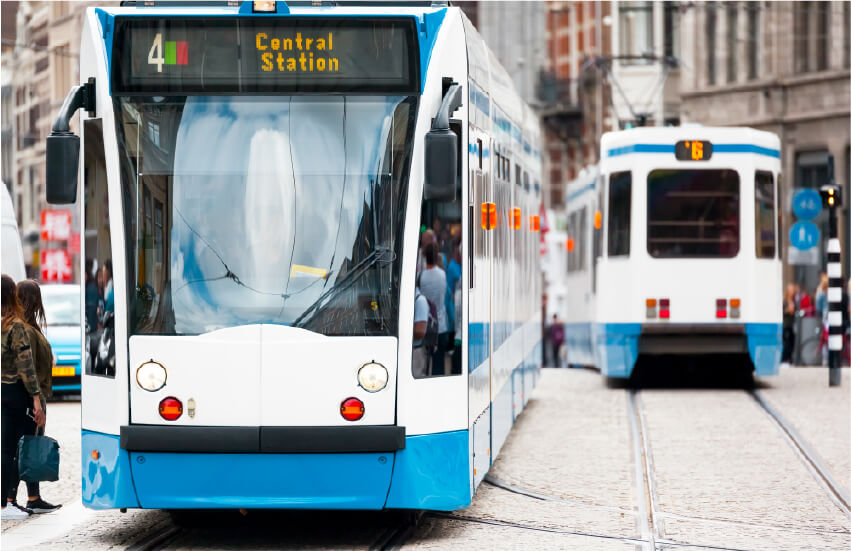
Cellular networks have long been used to improve the passenger experience. Rolled out on all London buses between 2007 and 2009 by Transport for London, the iBus, an Automatic Vehicle Location (AVL) system that tracked buses, provided passengers with audio-visual announcements and improved information on bus arrivals, and helped to trigger bus priority at traffic lights. The essential part of the system relied on GPS data combined with other signals such as speed and temperature and transmitted over cellular networks. The system has been in use for about 17 years and is now being replaced with a new, more sophisticated one. This new generation iBus will also reduce the amount of time that vehicles are out of service and waiting for a repair.
Fleet Operations and Maintenance
The same cellular path moves continuous Computer-Aided Dispatch (CAD) and Automatic Vehicle Location (AVL) telemetry plus sensor data from the vehicle. With a steady uplink, controllers can grant signal priority, and reroute around disruptions, while technicians receive diagnostics for predictive maintenance: fault codes, temperatures or battery state of charge for electric buses. Carrier and modem failover ensures connection continuity: with multiple carriers and multi-modem gateways, a bus or a tram can fail over in milliseconds when coverage fails, keeping operational data flowing while the vehicle is in motion. Cellular connectivity also allows for easy scaling, since there is no roadside infrastructure to build and no spectrum to manage. The result is higher reliability, fewer breakdowns with faster recovery, and overall better use of vehicles and crews.
Operators already use cellular networks for monitoring and maintenance purposes. For instance, DB Regio Bus has equipped almost all of its 5000 buses with telematics devices that leverage cellular connectivity to report, process and analyze technical anomalies, from information about the brake pads and individual fault codes, to other important indicators of vehicle condition.
Cellular connectivity is important not only for moving vehicles. In railway transportation, cellular data can be used for remote monitoring of overhead line systems. For example, Network Rail is fitting cellular modem technology to find and fix faults in overhead line equipment. The technology is installed into the substations that supply electricity to overhead line wires and works by sending data using 4G and 5G signals. It can pinpoint the location of the fault to about 300 to 400 meters of accuracy, a major improvement over earlier methods that sometimes could only narrow a fault to roughly 17 km.
Safety and Security
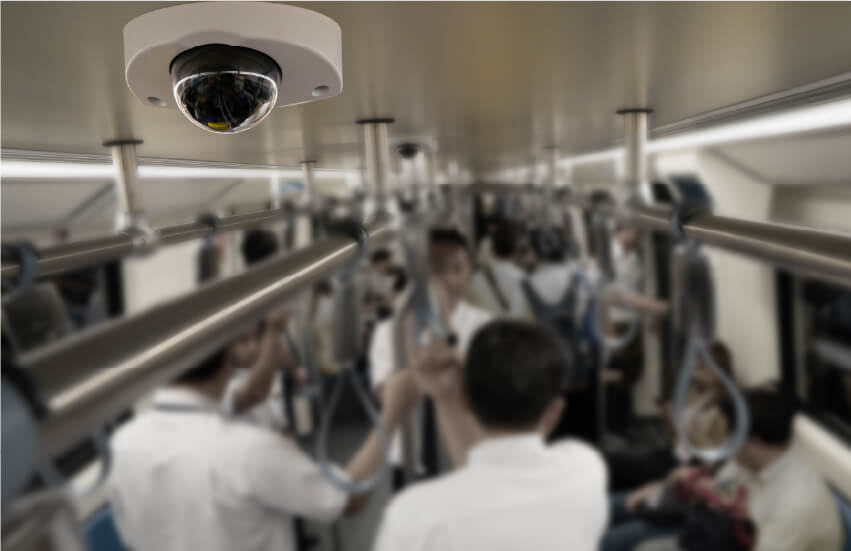
Onboard cameras, panic buttons, and other monitoring systems use a cellular link to send video feeds and alerts to control centers in real time. The same connection supports secure remote configuration and software updates. These capabilities let agencies respond quickly to incidents and maintain compliant and up-to-date systems, which is critical for creating a safer environment for passengers and staff.
Security use cases aren’t limited to surveillance on vehicles and at stations. Automated Bus Lane Enforcement systems detect and issue violation notices to clear dedicated bus lanes and improve passenger commute times. In 2024, the L.A. Department of Transportation deployed such systems in selected buses. Two cameras installed inside the windshield of the buses scan the bus lanes in real time. Once they detect a vehicle parked inside a bus lane or in front of a bus stop, they take videos and photos of the license plate to create an “evidence package” which is then transmitted over the cellular network to parking enforcement agencies for processing.
Fare Collection
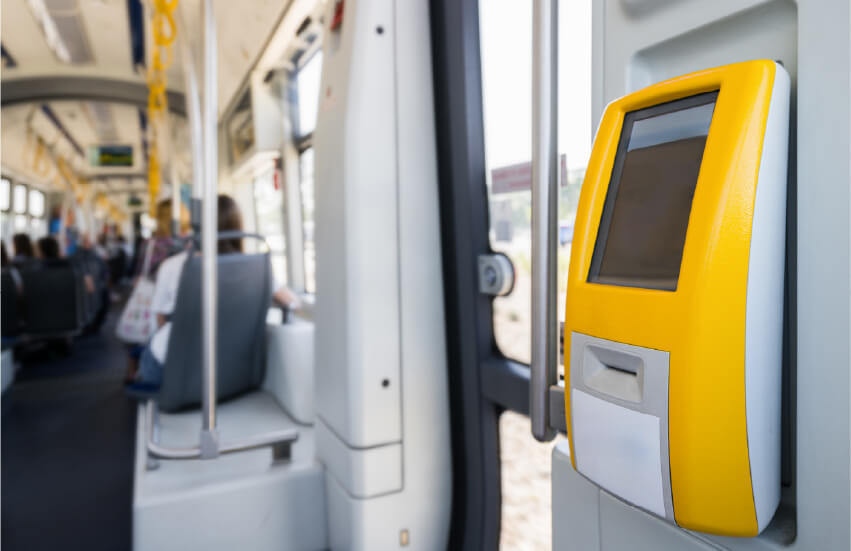
Various ticketing devices like validators, handheld inspecting devices, and even platform ticket validating machines (TVMs) that aren’t connected to fiber use the vehicle’s cellular link or a solar+cellular kit. They need it to authorize fares, refresh the cryptographic keys and certificates needed to verify tickets, and upload sales as they happen. At the same time, the system streams operational statistics such as passenger counts, how long a vehicle sits at a stop with doors open, on-time performance, and headway gaps, into analytics dashboards. Since all this works over cellular networks instead of waiting for a depot Wi-Fi upload, revenue and performance data stays complete and up to date throughout the day, enabling fast transactions and better service planning.
There are concrete deployments to point to. In 2023, Transport for Greater Manchester rolled out Ticketer’s electronic ticket machines (ETM), on-bus ticketing units that drivers and validators use to sell, validate, or inspect fares, across franchised buses. ETMs connect to the Ticketer Smart Gateway, which provides cellular-enabled connectivity for on-bus IT infrastructure.
Connectivity Requirements for Public Transport Vehicles
Due to similar applications, public transport vehicles mainly have common connectivity needs.
Wide Network Coverage
Without a stable connection, critical functions like real-time location tracking, driver communication, and alerts can be delayed or lost entirely. Since public transport vehicles are constantly on the move and may operate across cities and regions, including rural and remote locations, they need access to more than one mobile network. That means that your connectivity solution should be using SIM cards that can roam across multiple networks or switch carriers, like eSIMs. That implies contracting with multiple mobile operators, which is complex and can be costly both in terms of time and money.
Low Latency
Latency is a key factor in fleet management because many operations depend on real-time communication. For example, when a vehicle requests a signal priority or must be rerouted due to road closures, low latency ensures it happens in time. In emergencies, like accidents or breakdowns, alerts need to be immediate. Onboard video systems that monitor buses or bus lanes also depend on low latency.
Technically, cellular connectivity can provide better latency compared to other connectivity methods, but it should be noted that latency depends on the architecture of your provider’s core network and may vary significantly.
Bandwidth
Some applications, like live camera feeds or software updates, need more data. It’s important to remember that a good connectivity solution allows higher bandwidth when needed without compromising critical updates like location tracking. Bandwidth can also affect over-the-air (OTA) software and firmware updates necessary for some devices.
Webbing’s Solution for Public Transport Vehicles
Webbing offers a connectivity solution that ensures global access to reliable and high-quality internet, with low latency and the best of class coverage. It provides secure and continuous internet connection for all types of devices used by public transportation agencies, wherever and whenever they need it.
Our ecosystem of 600+ mobile operators guarantees worldwide coverage and allows to roam on several carriers’ networks in every region, solving the problem of weak spots that any mobile network may have and ensuring full coverage and continuous connectivity even at remote locations.
Webbing is a global connectivity provider with a distributed full core network with local breakouts, multiple network solution, and data server redundancy that provides connectivity stability and low latency. As such, Webbing’s network allows for realization of most complex scenarios with different types of devices, high-data consumption and industry-specific requirements.
Our eSIM solution guarantees failover connectivity with the capability of using multiple mobile carrier profiles, easily changing carriers at any time with zero integration, and an option to fall back from a failing profile to a different profile without any need to communicate with a remote server or deal with multiple SIM cards. Easily set business rules help determine automatic profile allocation based on location and enable fallback mechanisms in case of network failure or coverage issues.
A flexible approach to data packages allows us to tailor our connectivity offering for every customer based on the type of connected devices and their data consumption needs as well as the locations where the devices are used, aiming at overall optimization of the total cost of operations for the client.
Our solutions help public transportation agencies overcome their connectivity challenges and optimize costs for global deployments, providing the benefits of roaming with multiple carrier options in every country, and seamless transition between carriers, public and private networks, while maintaining low rates and low latency on a global scale with a single SIM.
Reach out to learn more about Webbing’s customized connectivity solutions for public transportation.