

Fleet expansion and regulation are increasing the need for reliable cellular connectivity
by Webbing Team | May 5, 2026
In 2023, we published a blog that discussed how cellular connectivity helped micromobility growth.
It was the year when the micromobility sector finally recovered from the pandemic: people in the US and Canada took 157 million trips on bike and scooter share, surpassing the previous peak of 147 million trips in 2019. In 2024, the industry continued to evolve and grow, with another year of record-breaking ridership and a substantial 31% increase in trips.
According to experts, this positive trajectory will continue. About 70 percent of global consumers are willing to use electric kick scooters and regular and electric bicycles, while about 60 percent of European and American cities are building new micromobility infrastructure and providing tax subsidies for micromobility products.
It’s no wonder that with the increase in demand, the number of micromobility vehicles keeps growing as well. According to NABSA, in 2024, 415 cities across North America had one or more shared micromobility systems, and the total shared micromobility vehicles deployed across North America increased by 19% from 2023 to 333,000. Last year, Berg Insight reported that the global shared micromobility fleet reached 27.6 million vehicles in 2024 and is expected to grow to 37.8 million by 2029.
But what do all these changes have to do with connectivity?

Staying Compliant: The Regulatory Push for Real-Time Data
As the micromobility sector has matured, cellular connectivity has become essential not only for operations, but also for meeting regulatory requirements. In the past, many fleets could rely on delayed data or the rider’s phone and still stay compliant, because cities treated micromobility as a trial. Over the last three years, this has changed. Cities now treat micromobility as part of public infrastructure and require operators to provide real-time data, enforce parking rules, and follow digital regulations as part of their permits.
Examples are abundant. Long Beach’s 2025 shared micromobility permit explicitly authorizes the city to implement a “third-party platform to supply real-time data for tracking shared micromobility use and compliance.” In Seattle, as a permit requirement, each company operating bike share or scooter share must host real-time data in an API feed. In Bergen, Norway, operators are required to share real-time data through MDS Agency API to monitor the number of vehicles each operator has on the street, areas where scooters are not allowed at all, as well as slow and no parking zones.
Remote Control: Keeping Fleets Connected and Secure
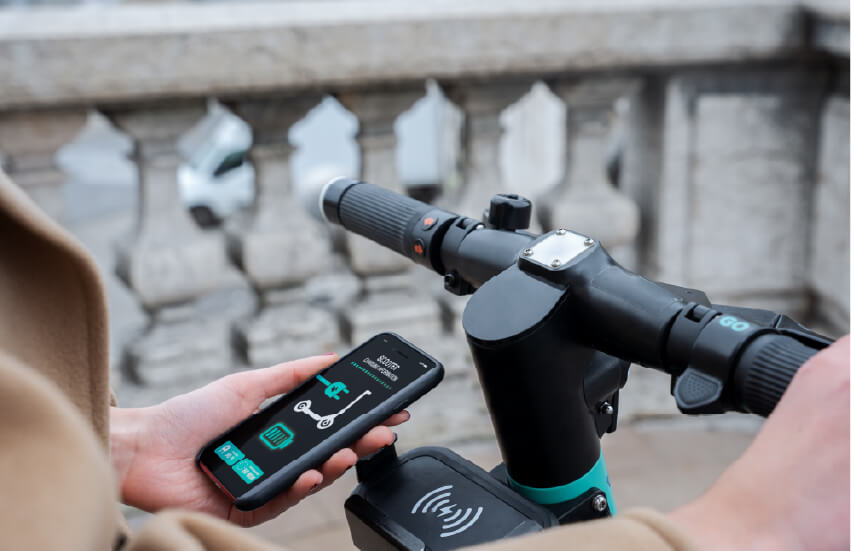
Cellular connectivity is critical for micromobility because it acts as the control and communication layer between vehicles, operators, users, and cities. Effectively, it is the mechanism that allows vehicles to be safely operated and monetized.
Vehicle availability and access control, theft detection, vehicle recovery all require stable connectivity. If a vehicle goes “dark” due to a lost connection, it effectively disappears from user apps and operator dashboards. It can also be stolen or tampered with, or damaged without the fleet operator knowing.
As fleets scale, firmware-over-the-air (FOTA) updates become another important use of cellular connectivity. Operators use them to fix security issues, improve performance, update battery management, and comply with new regulations, all without physically accessing the vehicle. Without FOTA updates over cellular networks, maintaining a large fleet would require constant manual work.

Smarter Fleets Through Telematics
Battery and power system monitoring has also become more important, especially as battery safety attracts increasing regulatory attention. Cellular connectivity allows continuous reporting of battery state, temperature, and health metrics. This enables early detection of faults or fire risks and supports preventive maintenance.
Telematics has been a key element since the inception of shared micromobility services. Bike sharing technology vendors provide complete solutions including telematics hardware, user identification, bike locks, station infrastructure, user applications and fleet management platforms. According to Berg Insight research, vehicle manufacturers now equip shared scooters and bikes with factory-installed telematics systems as standard. For instance, Spanish electric scooter manufacturer Silence uses cellular connectivity for fleet management, tracking, security alerts, and maintenance.

What Micromobility Demands from Connectivity
With so many use cases, the role of cellular connectivity is expected to grow. Experts predict that both fleet operators and vehicle manufacturers will rely on it more in the coming years. Transforma Insights estimated that in 2024, short range connectivity (particularly Bluetooth) was the primary communications technology for 77% of new devices, but by 2034, its share will decline to 33%, while 4G and 5G combined will account for two-thirds of the market.
What exactly is important in terms of connectivity? Let’s look at the main demands of micromobility vehicles:
Always-On Coverage
Shared vehicles are distributed across an entire city and often left unattended. In order for operators to track their location and receive status updates, they must be able to communicate anytime and anywhere without relying on user phones or Wi-Fi. Even when they are in use, a lack of reliable coverage can lead to issues such as billing errors and compliance problems. Since every network may have its blind spots, it is crucial to have mechanisms that ensure reliable coverage, such as multi-network SIMs and fallback options.
Reliable Real Time Communication
Many functions that are critical for shared bikes and scooters depend on fast data exchange, such as vehicle unlocking, trip start and end confirmation, rule enforcement, and fault reporting. Delays or failures may not be dangerous, but they can directly affect user experience and regulatory compliance.
Micromobility does not require ultra-low latency like autonomous driving, but it needs predictable and reliable response times. Cellular connectivity can support both requirements, as it is capable of delivering latency as low as 1ms. However, it is important to remember that actual latency depends on your connectivity provider’s network architecture, since any data must travel all the way to provider’s data center before going to its destination.
Connectivity That Grows and Adapts
Fleet operators need to manage thousands of vehicles, so connectivity must scale easily and be flexible. Because of changes in contracts or local regulations, operators may need to move fleets or adjust connectivity without replacing hardware. That’s not hypothetical: for example, Melbourne ended shared e-scooters program in September 2024, and in Madrid, banned rental e-scooters from October 2024. That’s why connectivity solutions must support remote provisioning and full lifecycle management across the entire fleet.

How Webbing Powers Micromobility Connectivity
Webbing offers a connectivity solution that ensures global access to reliable and high-quality internet, with low latency and the best of class coverage. It provides secure and continuous internet connection for all types of connected vehicles, wherever and whenever they need it.
Our eSIM solution guarantees failover connectivity with the capability of using multiple mobile carrier profiles, easily changing carriers at any time with zero integration, and an option to fall back from a failing profile to a different profile without any need to communicate with a remote server or deal with multiple SIM cards. Easily set business rules help determine automatic profile allocation based on location and enable fallback mechanisms in case of network failure or coverage issues. Webbing also offers a centralized way to manage eSIMs throughout their lifecycle, making deployments future-proof and eliminating the problem of everchanging legislation.
Webbing’s distributed core network infrastructure, with data centers on every continent, enables local breakout of traffic. This architecture can support low latency communication and helps meet local regulatory requirements while maintaining a unified global deployment.
A flexible approach to data packages allows us to tailor our connectivity offering for every customer based on the type of connected devices and their data consumption needs as well as the locations where the devices are used, aiming at overall optimization of the total cost of operations for the client.
Our solutions help companies that deploy connected micromobility fleets overcome their connectivity challenges and optimize costs for global deployments, providing the benefits of roaming with multiple carrier options in every country, and seamless transition between carriers, while maintaining low rates and low latency on a global scale with a single SIM.
Reach out to learn more about Webbing’s customized connectivity solutions for connected micromobility fleets.