
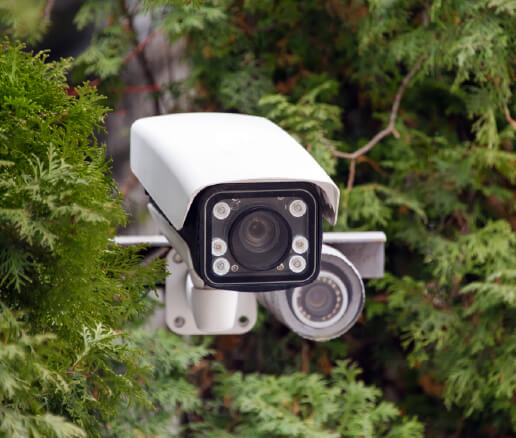
The meaning of latency, bandwidth, uptime and redundancy for live monitoring and video analytics
by Webbing Team | May 12, 2026
In one of our previous blogs, we explained why cellular connectivity is important for video surveillance systems. Over the last few years, adoption of CCTV cameras has increased significantly, and experts forecast there will be almost 150,000,000 cellular connected cameras at the end of 2035. This growth is driven by two main factors.
First, the range of use cases for video surveillance has expanded well beyond traditional security monitoring. CCTV deployments are now used for disaster monitoring, crowd management, public-safety operations, health emergency alerts, transportation oversight etc.
The second major shift is the growing adoption of AI-powered video analytics. In traditional CCTV systems, live monitoring was primarily performed by human operators sitting in control rooms. Today, surveillance platforms increasingly rely on AI. Autonomous monitoring reduces the operational burden on staff, and helps reduce false alarms and human error. This has significantly reduced the cost of operating a large number of public CCTV cameras and drove the rapid growth in surveillance devices in recent years.
These processes are changing the connectivity requirements of video surveillance systems. Continuous video transmission and reliable analytics performance translate into higher uplink bandwidth, lower and more predictable latency, and other demands that mobile networks need to support. Let’s see what the most important connectivity requirements for cellular enabled video surveillance are and why:
Latency: The Most Unpredictable Factor
In simple terms, latency is the delay between when the data is transmitted and the moment it reaches its destination. The time it takes for data to travel across the cellular network can be affected by various factors, such as network type, the distance between the device and the cell tower, network congestion, and the technology being used (e.g., 4G, 5G). Connectivity providers typically aim to minimize this delay to ensure a high-speed connection. Latency is one of the key factors to consider when choosing a connectivity provider for specific deployments.
In IP video surveillance, overall latency consists of different delays added by consecutive steps in the process of live video streaming. They all contribute to the total latency, but to different degrees.
The latencies on both ends of the process mainly depend on the hardware and software. The processes on the camera side, like capturing, image processing, compression, and packaging usually add a small fraction of the total latency. On the client side, the latency is often most heavily affected by the receiving buffer (this can be significant, up to several seconds). In the middle, the network also introduces latency. It is the most unpredictable factor, as it can vary dramatically depending not only on the hardware and software used by the connectivity provider but on the network architecture itself.
In many cases, network latency is the main contributor to the end-to-end delay. However, it can become more predictable with careful network management and bandwidth allocation. But what is bandwidth and why is it important?
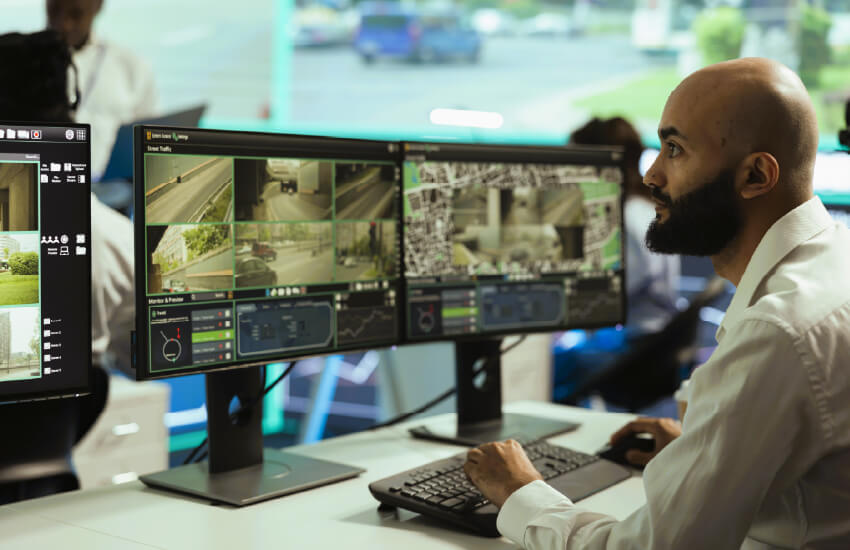
Bandwidth: Keeping Up With Growing Demand
Closely linked with latency, bandwidth is the maximum capability of the connection, i.e. how much data the network can potentially handle. The bandwidth depends on quality and architecture of the network infrastructure, including switches, routers, cables, proxies, etc. If the capacity of the network is increased, more data can pass through, which helps lower latency.
Bandwidth requirements grow as surveillance technology evolves. For instance, a 1080p IP camera can produce roughly six times more pixels than a legacy D1 analog CCTV camera, significantly more data to transmit and store. Multi-camera systems and AI enabled video analytics further increase bandwidth requirements by streaming larger amounts of video and metadata in real time. Aside from that, on public mobile networks, uplink capacity can be a problem for surveillance systems, because uplink performance is often less stable than download speeds.
To tackle the problem of insufficient bandwidth, sometimes the video quality may be intentionally reduced, or cameras can be configured to only record at certain times or when certain events are detected. However, it is important to remember that while it can help lower bandwidth consumption, it may also reduce visibility and increase the risk of missing critical events or context.

Uptime: Minimizing the Cost of Downtime
Uptime measures how continuously available and operational the surveillance system is over time. It is usually expressed as a percentage, for example, 99.9% or 99.99%. The difference in these numbers mean major differences in operational risks: for example, over 30 days, 99.9% uptime allows for about 43 minutes of downtime, and 99.99% limits downtime to approximately 4 minutes.
While video surveillance systems don’t have a universal mandated uptime standard, depending on the specific usage scenario, it can significantly impact situational awareness and result in missed incidents or compliance failures. That’s why in public safety, transportation, industrial operations, and even retail, CCTV deployments are often designed to guarantee a 99.99% or higher uptime.
Cellular networks help surveillance systems improve uptime. With the emergence of 5G, they can support a vastly greater number of devices, provide smoother handoffs between radios, and guarantee better security thanks to enhanced encryption. Bosch reported that private 5G deployments can achieve 99.9999% reliability inside factories.

Redundancy: Eliminating Single Points of Failure
Since even the best systems, networks, power sources, storage solutions and other hardware components may fail, one of the most important requirements in live video surveillance is redundancy. Simply put, it is the duplication of critical components or connectivity paths to ensure the system continues operating if one component fails.
There are different approaches to ensuring redundancy in video surveillance systems. One of them is a dual network connection that helps ensure there is no single point of failure and data can be transmitted via the alternative route. Some systems may use dual SIMs or network bonding. One of the most reliable options is multi-carrier access.
Another redundancy mechanism implies localized storage to protect IP video data in the event of network failure. Many IP cameras and encoders are equipped with SD memory cards or internal hard drive storage that can be used as a backup if a network interruption or failure occurs. It is important to note that in some instances a short delay can occur between network failure and the camera detecting the issue and switching to localized storage (up to four or five seconds).
Another way to improve system resilience is real time system health monitoring. It is an integral feature of some surveillance management platforms that helps identify indicators of potential failure and alerts operators or even hot swaps digital recording systems automatically. However, this also requires stable and reliable connectivity to exchange status information, telemetry, alerts, and commands.

How Webbing Delivers on Every Connectivity Requirement
Webbing offers a connectivity solution that ensures global access to reliable and high-quality internet, with low latency and the best of class coverage. It provides secure and continuous internet connection, delivering a streamlined, centralized, and scalable means of deploying, controlling and monitoring video surveillance cameras.
Webbing’s IoT ecosystem spans 600+ mobile carriers in more than 190 countries and regions, which reduces dependency on a single operator and allows devices to roam seamlessly across multiple carriers’ networks in every region. It solves the problem of weak spots that any mobile network may have and ensures full coverage and continuous connectivity for all surveillance units, even at remote locations. Additionally, our eSIM solution guarantees failover connectivity with multiple mobile carrier profiles, with an option to fall back from a failing profile to a different profile without any need to communicate with a remote server.
Webbing is a full MVNO that owns its core network, which is a fully redundant, distributed network with data centers on every continent. It features local breakouts and a variety of network solutions to support high-performance connectivity, and allows to guarantee high bandwidth and low latency to all connected devices.
Webbing’s core network is well suited to support all types of use cases, including mission-critical and high-data consumption. We do not throttle or restrict data at any level but enable the capability for customers to throttle as they see applicable with our on-demand usage control policies.
Webbing also offers a centralized way to manage eSIMs throughout their lifecycle, making deployments future-proof. With our solutions, operators can define business rules that automatically change the serving carrier based on location, connectivity quality, regulatory constraints, or time-based conditions.
A flexible approach to data packages allows us to tailor our connectivity offering for every customer based on the type of connected devices and their data consumption needs as well as the locations where the devices are used, aiming at overall optimization of the total cost of operations for the client.
Our solutions help enterprises overcome their connectivity problems and reduce time to market for global deployments, providing the benefits of roaming with multiple carrier options in every country, and seamless transition between carriers, while maintaining low rates and low latency on a global scale with a single SIM.
Reach out today to learn more about Webbing’s connectivity solutions for video surveillance systems.