

What the rise of SDVs, deployable autonomy, and AI means for OEMs and their connectivity strategy
by Per Gadenius | April 14, 2026
Three years ago, we published a blog on how connectivity shapes key automotive trends and the broader industry. Now it is the time for another review, as those trends are evolving. Let’s take a look at how these trends are changing, what that means from a connectivity perspective, and how Webbing’s solutions fit into the picture.
Overall, cars are becoming more software centric and data driven, and more dependent on high performance computing.
While trends may change, the importance of connectivity only becomes greater. As vehicles are becoming increasingly software defined, continuous and universal connectivity enables them to communicate with their environment, collect real time data and send it to the cloud. Using this data, connected services and features are delivered and continually enhanced using over-the-air (OTA) updates.
The impact of connectivity is wider than the development of technology alone. It is reshaping the whole automotive market: traditional automotive OEMs are shifting focus from simply manufacturing and selling vehicles to offering upgradeable platforms and generating recurring revenue streams through connected services subscriptions.
Major OEMs have already launched their own connected services, although many are still in the early stages of adoption. As more OEMs introduce connected car services, their quality and offering become increasingly critical. OTA update capability and cloud infrastructure are essential to a successful connected services business model, prompting OEMs to pursue region specific, multivendor cloud strategies. At the same time, setting up the right architecture and data governance framework remain challenging, and many OEMs are struggling to promote connected car services and convert free trials into paid subscriptions.
Although the potential is significant, many automakers have not yet fully monetized these connected car services. However, this is expected to change dramatically as the industry accelerates toward the software defined vehicle future, with AI-powered service recommendations, AI-generated content, more natural interactions, and more advanced levels of autonomy.

Software-Defined Vehicles: When the Car Becomes a Platform
The industry’s shift toward software-defined vehicles (SDV) is still a key focus of automotive technology news. The SDV market is taking off, changing the automotive landscape by embedding sophisticated software capabilities into conventional vehicle functions. Instead of being an add-on, automotive software is becoming central to how the car feels and works.
The integration of OTA (over-the-air) technology allows OEMs to provide continuous improvements to vehicle performance and features without the need for service visits. This capability keeps vehicles up-to-date with the latest advancements and fixes, but what is more important is that cars aren’t static anymore. They can evolve over time, as automakers can quickly deploy new features to improve safety and deliver better experiences continuously. Cars that can learn, adapt and keep improving will stand out in the years to come.
With software scalability, every update has the potential to reach millions of drivers across multiple models, extending the value of innovation far beyond a single release.
What does that mean from a connectivity perspective?
With vehicles relying on software for features and diagnostics, connectivity must support regular OTA updates, remote provisioning, and continuous backend communication. It needs to ensure high downlink capacity for OTA campaigns, dependable background connectivity over years of vehicle life, and traffic prioritization to make sure that bulk downloads do not interfere with critical services.
Moreover, connectivity becomes a regulatory challenge. It should provide cross-border scalability, which implies compliance with regulatory requirements and remote SIM management in various markets. For SDVs, the most relevant regulations are the industry specific ones that govern cybersecurity and software updates, as well as emergency connectivity like eCall rules. But aside from vehicle specific regulations, there are telecom rules and market limits around permanent roaming. They remain highly relevant for globally deployed SDVs because they may require different SIMs for each country that OEMs ship vehicles to. Data sovereignty regulations may also force more localized eSIMs and complex architectures. Depending on the legislation, it may be important that IP traffic stays in the country, vehicles use an IMSI from a local operator, or both local SIM profiles and connectivity services come from a local carrier. It’s not a minor issue: for example, when Turkey introduced data sovereignty rules requiring connected cars to use local SIMs and keep relevant data in-country, some automakers had to disable certain eCall services in vehicles already shipped there to avoid falling under the regulation.
Where can Webbing solutions help?
With Webbing, OEMs can launch globally with a single solution, eliminating the need for multiple SKUs and complex regional adaptations, even in the most regulated markets, such as Turkey. Our multi-IMSI and eSIM technology dynamically aligns connectivity with local regulatory requirements, overcoming permanent roaming limitations. Advanced localization capabilities (IP, soft, and full localization) ensure compliance with data sovereignty regulations and in-country routing demands. Built-in support for local operator profiles, including requirements like eCall, enables full alignment with automotive regulations. Webbing’s solutions provide borderless connectivity with local compliance built in and faster time-to-market for connected vehicle programs. Moreover, their architecture is scalable and future-proof, so they can evolve with regulatory and technological changes.
From Full Self-Driving Dreams to ADAS Reality
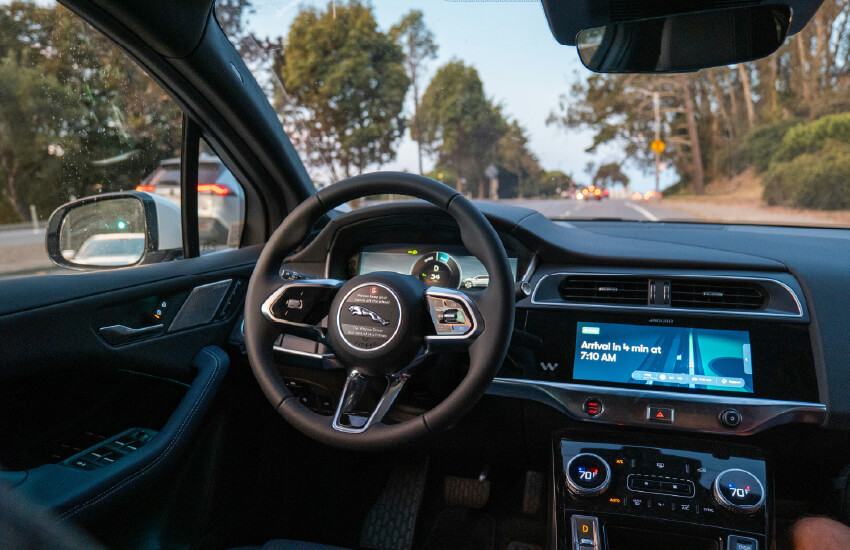
Experts say that while OEMs continue to make long-term investments in fully autonomous vehicles, they have shifted their investment focus to more immediate opportunities, such as advanced driver assistance systems (ADAS) and connected services. The center of gravity in autonomous driving is not a sudden jump to mass-market fully driverless cars but rather more capable ADAS and “deployable autonomy” strategies that OEMs can actually commercialize.
OEMs and suppliers are building autonomy through practical layers that can deliver value sooner. By March 2025, S&P Global reported that multiple Chinese automakers (BYD, Zeekr, XPeng, Li Auto and NIO) were all preparing Level 3 launches, while Mercedes-Benz and BMW had already brought Level 3 systems to market, showing that autonomy is advancing through selective, commercially viable deployments. That includes highway assistance, automated parking, better driver monitoring, more advanced perception stacks, and connected features that improve performance over time.
What does that mean in terms of connectivity?
ADAS becomes more advanced, and vehicles increasingly need connectivity for specific functions, not just general telematics. The main requirements come from OTA updates for driving software, HD map updates, road hazard and traffic updates, remote diagnostics, and in some cases cooperative safety services such as C-V2X. 5GAA’s current service level requirements work shows that some cooperative and safety scenarios call for roughly 120 ms latency, 99.99% reliability, and about 1.5 m positioning accuracy, while richer cooperative perception can need much higher data rates than legacy telematics.
In real life, this translates into requirements for lower and more predictable latency, very high reliability for safety relevant and mission critical data, and seamless handover at highway speeds. On top of that, despite progress in 5G and satellite-based connectivity, coverage continuity is still a core challenge because every terrestrial operator still has dead zones, and the NTN segment is developing mainly as a fill-in solution for remote or disrupted areas, not yet a ubiquitous service.
Where can Webbing solutions help?
Webbing supports connected ADAS and autonomous driving programs by improving coverage continuity, reducing dependency on any single operator, and enabling more stable low-latency connections for vehicle data flows. Our connectivity approach combines access to multiple carrier networks, seamless transition between carriers, local breakout, and failover capabilities, which is useful for use cases such as HD map updates, road context data, remote diagnostics, and other driving functions that depend on continuous service at highway speeds. Webbing also provides centralized monitoring, and control of connected vehicle fleets, helping OEMs manage connectivity performance across various regions while keeping the architecture scalable.

AI Takes the Wheel — and the Cabin, and the Cloud
Experts say that the CES 2026 conference demonstrated what has changed in the automotive industry’s priorities. With demand for electric vehicles softening and regulatory and cost pressures mounting, automakers and suppliers are emphasizing automotive technology like artificial intelligence (AI) rather than electrification.
There are many applications for AI. For example, this year NVIDIA demonstrated at CES Alpamayo, a 10-billion-parameter model designed to help vehicles reason and navigate complex, unpredictable driving scenarios. The system reflects growing industry focus on “physical AI,” which relies on large-scale simulation and computer-generated data that mirrors real world conditions.
Voice and AI assistants also continue to evolve from hands-free interfaces into predictive co-pilots. Mercedes-Benz and Volkswagen are now embedding large language models for in-car queries and maintenance guidance. Today’s platforms combine advanced speech recognition with generative AI to enable seamless, hands-free control of navigation, entertainment, climate and more, but the focus is on making interactions even more natural and intuitive. Rather than relying on general purpose AI, manufacturers are increasingly turning to domain specific automotive language models trained on navigation data and safety rules to improve reliability. Multimodal capabilities that interpret gestures, gaze and situational context promise to reduce driver distraction and change the way people interact with their cars.
Another important application of AI is safety: it can predict the next six or seven seconds and avoid collisions before they happen. Industry experts expect that AI will be able to reduce vehicle collisions by 90 percent, becoming the first technology to outperform the seatbelt in terms of reducing fatalities and serious injuries.
What does that mean from a connectivity perspective?
AI-driven cockpits, predictive maintenance, and context-aware services increase both the volume and complexity of data exchanged between vehicle and cloud. Last year, the Automotive Edge Computing Consortium called on global MNOs to enhance existing network infrastructure capabilities, so they align with the automotive industry’s growing connectivity needs. With the rise of intelligent driving, cars must efficiently handle data bursts from maps, video, diagnostics, and model-related telemetry, and networks must evolve to support varying traffic volumes and a variety of latency requirements. In addition, connected cars that use AI need stronger uplink as well as downlink, because cars increasingly generate valuable data.
Where can Webbing solutions help?
Webbing’s solutions guarantee stable yet flexible connectivity that supports large and variable data flows between vehicle, edge, and cloud. Webbing’s platform is built for secure and continuous connectivity, with multi-carrier access, low latency local connectivity, remote eSIM orchestration, and centralized control over profiles and network behavior. Webbing’s orchestration and automation tools also help simplify scaling and implement flexible cost control, with tailor made data plans for each use case.

Webbing offers a connectivity solution that ensures global access to reliable and high-quality internet, with low latency and best-in-class coverage. It provides secure and continuous internet connection for all types of connected vehicles, wherever and whenever they need it.
Webbing has built a global connectivity ecosystem spanning more than 600 mobile operators worldwide. This allows connected vehicles to roam seamlessly across multiple carrier networks in different regions, reducing dependence on a single operator and helping overcome local coverage gaps.
Webbing already has extensive experience in the automotive realm. In 2025, Webbing partnered with Sibros, a provider of the SDV Deep Connected Platform™ that orchestrates full vehicle software update management, vehicle analytics, and remote commands in one integrated system. The partnership enables the secure transport of data between devices in the field and the cloud, facilitating essential data processing for insights and decision making.
Webbing’s advanced eSIM technology and global IoT connectivity platform also deliver reliable always-on connectivity for VinFast electric vehicles. It enables OTA updates, real time diagnostics, predictive maintenance, and dependable global eCall support, as well as enhances the driver experience with fast access to infotainment, navigation, maps, and cloud services.
Earlier, Webbing connectivity solution was implemented in ACTIA’s latest generation embedded telematics platform, ACU6. The partnership delivers an off-the-shelf telematics solution that simplifies vehicle telematics connectivity and reduces time to market for deployments, and won the IoT Breakthrough Award 2023 as the “M2M Vehicle Telematics Innovation of the Year”.
Reach out to learn more about Webbing’s solutions for connected vehicles.